

Palladium(II) trifluoroacetate

GTC-511

Palladium Compounds

Palladium(II) trifluoroacetate

CAS No.
42196-31-6
Catalogue ID
GTC-511

Palladium(II) trifluoroacetate, CAS 42196-31-6. Source-derived identification, physical data and applications are provided for catalogue reference; request the current specification, COA and SDS for the required grade.

Catalogue aliases / related identifiers

Palladium trifluoroacetate; Pd(TFA)2; Bis(trifluoroacetato)palladium(II); Palladium(2+) trifluoroacetate; Trifluoroacetic acid, palladium(2+) salt; Bis(trifluoroacetoxy)palladium; Palladium ditrifluoroacetate; Palladium(II) tris(trifluoroacetate) (misnomer, but sometimes used)

Supplied catalogue source: GTC-511 · Page 74

Reference data — confirm before ordering or use

The information below is a structured migration from the supplied catalogue snapshot. It is not a current product specification, COA or SDS. Confirm the actual supplier, grade, batch documents, classification, packing and destination requirements for your enquiry.


Basic Information of Palladium(II) Trifluoroacetate

CAS No.42196-31-6
EC No.255-718-7
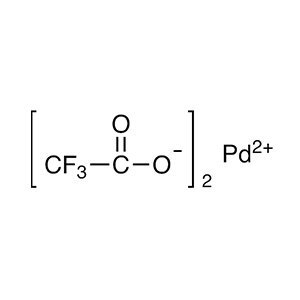
Chemical FormulaPd(C₂F₃O₂)₂
Molecular Weight332.44 g/mol
AppearanceBrown to dark brown crystalline powder
OdorOdorless to slight acetic-like
Melting pointDecomposes before melting (>200 °C)
Boiling pointNot applicable (decomposes)
Densityapprox. 2.1–2.3 g/cm³
SolubilitySoluble in acetone, acetonitrile, THF, dichloromethane; sparingly soluble in water
Nature (hazards)Causes severe skin burns and eye damage, may cause allergic skin reaction, harmful if swallowed, toxic to aquatic life
RIDADRUN 3260, Corrosive solid, acidic, inorganic, n.o.s. (Palladium(II) trifluoroacetate), Class 8, Packing Group III
Chemical StructureMolecular Structure of Palladium(II) Trifluoroacetate

Primary Applications of Palladium(II) Trifluoroacetate

Palladium(II) Trifluoroacetate is a powerful electrophilic Pd(II) source, excelling in challenging C–H functionalizations and oxidative processes where enhanced Lewis acidity is critical. The strongly electron-withdrawing trifluoroacetate ligands increase the electrophilic character of the palladium center, facilitating activation of otherwise inert C–H bonds. It is widely employed in systems described in palladium-mediated pharmaceutical and fine chemical synthesis, particularly for late-stage functionalization and oxidative coupling strategies.

  1. C–H Activation & Functionalization
    Enables highly selective direct C–H arylation, acetoxylation, olefination, and amidation of arenes, heterocycles, and aliphatic C–H bonds, providing efficient routes to complex molecules with minimal prefunctionalization. The increased electrophilicity of Pd(II) promotes metalation steps and supports Pd(II)/Pd(IV) redox cycles in oxidative transformations.

  2. Oxidative Couplings & Dehydrogenative Reactions
    Catalyzes oxidative C–C, C–N, and C–O bond formations using air or stoichiometric oxidants, delivering atom-economical access to biaryls, enones, and heterocycles in fine chemical synthesis. Trifluoroacetate ligands can stabilize high-valent palladium intermediates during catalytic turnover.

  3. Allylic & Vinylic Functionalization
    Promotes regioselective allylic oxidation, acetoxylation, and amination, offering superior control in the synthesis of natural products and pharmaceutical intermediates. Ligand effects influence regioselectivity and reaction kinetics.

  4. Pharmaceutical & Natural Product Synthesis
    Widely applied in late-stage functionalization and key steps of complex API and natural product total synthesis, leveraging its high reactivity and functional group tolerance. The absence of strongly coordinating halides simplifies downstream purification.

  5. Catalyst Development & Mechanistic Studies
    Serves as a standard electrophilic Pd(II) source for ligand screening, kinetic studies, and development of novel Pd-catalyzed oxidative systems in academic and industrial R&D. Its defined coordination environment allows systematic evaluation of reaction pathways.

  6. Materials & Polymer Chemistry
    Facilitates Pd-catalyzed modifications of polymers, aromatic frameworks, and functional materials requiring enhanced electrophilicity for selective transformations. Controlled C–H activation enables functionalization of complex substrates.

For a comprehensive overview of palladium material categories—including salts, oxides, supported catalysts, and organometallic systems across industrial sectors—refer to Palladium Compounds: Applications, Categories & Industrial Uses.


  • Superior Purity & Batch Consistency
    Advanced quality controls ensure uniform Pd content, minimal impurities, and reproducible catalytic activity across production lots.

  • Secure Palladium Sourcing
    Transparent, responsible procurement with inventory buffering to ensure supply reliability amid market fluctuations.

  • Technical Application Support
    Experienced catalysis team provides reaction optimization, oxidant/ligand synergy advice, scale-up guidance, and troubleshooting for maximum efficiency.

  • Comprehensive Regulatory Compliance
    Full documentation suite including Certificates of Analysis, REACH, RoHS, and detailed SDS to facilitate seamless global operations.

  • Sustainability Commitment
    Ethical sourcing practices and precious metal recovery/recycling programs aligned with modern ESG requirements and circular economy goals.


Hazards Classification

  • GHS Classification: Skin Corrosion/Irritation (Category 1B); Serious Eye Damage (Category 1); Skin Sensitization (Category 1); Acute Toxicity, Oral (Category 4); Aquatic Chronic (Category 2)

  • Hazard Statements: H314: Causes severe skin burns and eye damage; H317: May cause an allergic skin reaction; H302: Harmful if swallowed; H411: Toxic to aquatic life with long lasting effects

  • UN Number: UN 3260

  • Hazard Class: 8 (Corrosive substances)

  • Packing Group: III

GHS05
GHS05: Corrosive
GHS07
GHS07: Exclamation mark (sensitizer, acute toxicity)
GHS09
GHS09: Environment (aquatic toxicity)
Before you order

Confirm the current commercial product record.

Include the required grade or purity, quantity, preferred packing, destination country/port and required document set.

  • 01Current specification
  • 02Batch or sample COA
  • 03Product- and supplier-specific SDS
  • 04Packing and shipping review
Request product review

INQUIRY

INQUIRY