[1,1′-Bis(diphenylphosphino)ferrocene]dichloropalladium(II)

GTC-069

Palladium Compounds

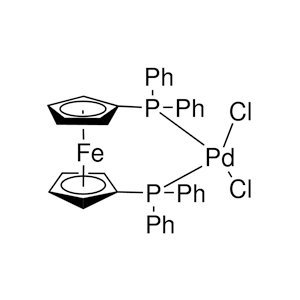
[1,1′-Bis(diphenylphosphino)ferrocene]dichloropalladium(II)

CAS No.
72287-26-4
Catalogue ID
GTC-069

[1,1'-Bis(diphenylphosphino)ferrocene]dichloropalladium(II), CAS 72287-26-4. Source-derived identification, physical data and applications are provided for catalogue reference; request the current specification, COA and SDS for the required grade.

Catalogue aliases / related identifiers

[1,1'-Bis(diphenylphosphino)ferrocene]palladium(II) dichloride; Pd(dppf)Cl2; Dichloro[1,1'-bis(diphenylphosphino)ferrocene]palladium(II); Palladium(II) [1,1'-bis(diphenylphosphino)ferrocene] dichloride; 1,1'-Bis(diphenylphosphino)ferrocene-palladium(II) chloride; PdCl2(dppf); (dppf)PdCl2

Supplied catalogue source: GTC-069 · Page 71

Reference data — confirm before ordering or use

The information below is a structured migration from the supplied catalogue snapshot. It is not a current product specification, COA or SDS. Confirm the actual supplier, grade, batch documents, classification, packing and destination requirements for your enquiry.


Basic Information of [1,1'-Bis(diphenylphosphino)ferrocene]dichloropalladium(II)

CAS No.72287-26-4
EC No.276-642-4
Chemical FormulaC₃₄H₂₈Cl₂FeP₂Pd
Molecular Weight731.70 g/mol
AppearanceRed to reddish-brown crystalline powder
OdorOdorless
Melting pointDecomposes >260 °C
Boiling pointNot applicable (decomposes)
Densityapprox. 1.7–1.9 g/cm³
SolubilityInsoluble in water; soluble in dichloromethane, chloroform, toluene, THF
Nature (hazards)Harmful if swallowed, may cause long lasting harmful effects to aquatic life, air-sensitive in solution
RIDADRNot regulated (not subject to transport regulations as hazardous material in many classifications)
Chemical StructureMolecular Structure of Pd(dppf)Cl₂

Primary Applications of [1,1'-Bis(diphenylphosphino)ferrocene]dichloropalladium(II)

Pd(dppf)Cl₂ remains a gold-standard precatalyst, delivering superior performance in challenging cross-coupling reactions due to the unique electronic and steric properties of the dppf ligand. The dppf ligand’s rigid bidentate structure provides excellent π-acceptance and electron-donating abilities, enhancing Pd(0) activation and enabling high reactivity in challenging substrates. Pd(dppf)Cl₂ is widely used in systems described under cross-coupling catalysis, where robust reactivity, high functional group tolerance, and excellent reproducibility are essential.

  1. Suzuki-Miyaura Cross-Coupling
    Excels in coupling aryl/heteroaryl boronic acids with aryl/heteroaryl chlorides, bromides, and triflates, offering high yields and excellent functional group tolerance in pharmaceutical intermediate synthesis. The electron-donating diphenylphosphine ligands enhance the rate of oxidative addition, enabling efficient coupling even with challenging substrates.

  2. Negishi & Kumada Couplings
    Enables efficient C–C bond formation with organozinc or organomagnesium reagents, particularly effective for sterically hindered or electron-rich partners in fine chemical production. The bidentate nature of dppf promotes selective transmetalation and reductive elimination steps, ensuring high regioselectivity.

  3. Buchwald-Hartwig Amination & Etherification
    Facilitates robust C–N and C–O bond construction with amines, amides, alcohols, and phenols, providing access to key pharmacophores under mild conditions. Pd(dppf)Cl₂’s high stability under air and moisture makes it particularly useful for large-scale amination reactions.

  4. Stille & Hiyama Couplings
    Supports tin- and silicon-based cross-couplings with high selectivity, useful for synthesizing conjugated systems and complex natural product fragments. The dppf ligand's steric properties enhance selectivity, ensuring efficient coupling with functionalized organotins and organosilanes.

  5. Pharmaceutical API Manufacturing
    Widely adopted in multi-kilogram-scale Pd-catalyzed steps for active pharmaceutical ingredients, delivering process robustness, scalability, and regulatory-friendly performance. Its ability to tolerate a wide range of functional groups and substrates makes Pd(dppf)Cl₂ an ideal candidate for large-scale manufacturing.

  6. Catalyst Development & Ligand Screening
    Serves as a reliable Pd source for evaluating new ligands, mechanistic studies, and development of advanced palladium catalytic systems in academic and industrial R&D. The precise control over steric and electronic properties with dppf enables detailed studies of ligand effects and catalytic turnover rates.

For a broader overview of palladium material categories—including salts, oxides, supported catalysts, and organometallic systems across industrial sectors—refer to Palladium Compounds: Applications, Categories & Industrial Uses.


  • Superior Purity & Ligand Integrity
    Stringent quality controls ensure high Pd content, minimal free dba or impurities, and preserved dppf coordination for maximum catalytic activity and reproducibility.

  • Air-Sensitive Handling Expertise
    Specialized inert-atmosphere packaging and storage preserve compound stability from production to delivery, minimizing degradation in sensitive applications.

  • Secure Precious Metal Supply Chain
    Transparent, responsible palladium procurement with inventory strategies to provide supply continuity and price stability.

  • Technical Catalysis Support
    Dedicated specialists offer reaction optimization, ligand/base screening, scale-up guidance, and troubleshooting to enhance yield and selectivity.

  • Regulatory & Sustainability Compliance
    Comprehensive COA, REACH, RoHS, SDS documentation and palladium recycling programs aligned with global standards and ESG commitments.


Hazards Classification

  • GHS Classification: Acute Toxicity, Oral (Category 4); Aquatic Chronic (Category 4)

  • Hazard Statements: H302: Harmful if swallowed; H413: May cause long lasting harmful effects to aquatic life

  • UN Number: Not regulated

  • Hazard Class: Not classified as hazardous for transport

  • Packing Group: Not applicable

GHS07
GHS07: Exclamation mark (acute toxicity)
GHS09
GHS09: Environment (aquatic hazard)
Before you order

Confirm the current commercial product record.

Include the required grade or purity, quantity, preferred packing, destination country/port and required document set.

  • 01Current specification
  • 02Batch or sample COA
  • 03Product- and supplier-specific SDS
  • 04Packing and shipping review
Request product review

INQUIRY

INQUIRY