GHS Classification: Acute Toxicity (GHS06)
Hazard Statements: Highly harmful if swallowed or in contact with skin; may be harmful if inhaled.
UN Number: UN 3082
Hazard Class: 9
Packing Group: III
α-Pinene oxide
GTC-209
Packaging
Packaging to be confirmed
Ethers
α-Pinene oxide
- CAS No.
- 1686-14-2
- Catalogue ID
- GTC-209
α-Pinene oxide, CAS 1686-14-2. Source-derived identification, physical data and applications are provided for catalogue reference; request the current specification, COA and SDS for the required grade.
Catalogue aliases / related identifiers
Nsc5609; 2-pinene oxide; α-Epoxypinane; a-Pinene Oxide; α-pinene epoxide; 2,3-epoxypinane; 2,3-epoxy-pinan; 3-Oxa-tricyclo[4.1.1.0(2,4)]octane, 2,7,7-trimethyl-
Supplied catalogue source: GTC-209 · Page 14
Reference data — confirm before ordering or use
The information below is a structured migration from the supplied catalogue snapshot. It is not a current product specification, COA or SDS. Confirm the actual supplier, grade, batch documents, classification, packing and destination requirements for your enquiry.
α-Pinene Oxide, CAS 1686-14-2, is a bicyclic epoxide derived from the natural terpene, $\alpha$-Pinene. It is a key intermediate in the specialty chemical industry, valued for its unique, strained three-membered epoxy ring structure. This structure makes it highly reactive, enabling its conversion into a wide range of valuable downstream chemicals, particularly in the fragrance and flavor sectors. It is typically a colorless to pale yellow, clear liquid.
Basic Information of α-Pinene Oxide
| CAS No.: | 1686-14-2 |
|---|---|
| EC No.: | 216-869-6 |
| Linear Formula: | C10H16O |
| Molecular Weight: | 152.23 |
| Appearance: | Colorless to pale yellow clear liquid |
| Odor: | Characteristic fresh, piney, camphor-like odor |
| Boiling Point: | 185 °C |
| Density:0.964 g/mL at 25 °C (lit.) | 0.964 g/mL at 25 °C (lit.) |
| Solubility: | Immiscible with water; highly soluble in organic solvents (alcohol, ether, terpenes). |
| Flash Point: | 150 °F |
| RIDADR: | 3082 9/PG 3 |
| Chemical Structure: | 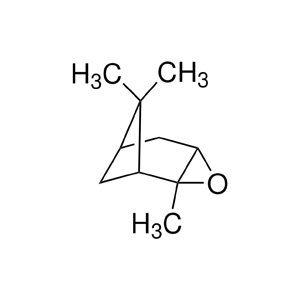 |
Application Overview
α-Pinene Oxide is a highly versatile chemical intermediate, primarily utilized for the selective synthesis of complex natural product derivatives:
Fragrance and Aroma Chemicals: It is a key precursor for the synthesis of high-value fragrance molecules. Ring-opening and rearrangement reactions lead to compounds like campholenic aldehyde, which is, in turn, an essential starting material for several synthetic musk fragrances (e.g., Cyclacene) and sandalwood notes.
Flavoring Agents: Derivatives of $\alpha$-Pinene Oxide are used to create specific minty, camphoraceous, or pine-like flavor notes for food and beverage applications, requiring high purity to meet regulatory standards.
Pharmaceutical Intermediates: Its strained epoxide ring is easily opened by nucleophiles, enabling the stereoselective synthesis of complex chiral alcohols and amino-alcohols. These are critical intermediates in the development of certain drug candidates and pharmaceutical precursors.
Polymer and Resins: It can be used as a co-monomer or reactive diluent in specialty polymer systems. The ring-opening polymerization of epoxides yields polyols, which are components of specialized polyurethane or epoxy resins, improving flexibility and adhesion.
Fine Chemical Synthesis: The molecule is employed in asymmetric synthesis as a chiral auxiliary or starting material, where its inherent stereochemistry is transferred to the final product.
Natural Origin Traceability: Our α-Pinene Oxide is synthesized from sustainably sourced natural $\alpha$-Pinene feedstock, providing full traceability from the natural source to the final product. This meets the growing consumer and regulatory demand for transparency in natural chemical supply chains.
Specialized Stabilization Protocol: Terpene oxides can be sensitive to heat and light. We utilize custom-designed packaging and dark storage environments to prevent thermal and light-induced degradation, guaranteeing that the high-quality odor and reactivity profile are preserved throughout shipping and storage.
Hazards Classification

Before you order
Confirm the current commercial product record.
Include the required grade or purity, quantity, preferred packing, destination country/port and required document set.
- 01Current specification
- 02Batch or sample COA
- 03Product- and supplier-specific SDS
- 04Packing and shipping review
INQUIRY
Continue browsing
Related Products
Tetrahydrofuran
- CAS No.
- 109-99-9
Tetrahydrofuran, CAS 109-99-9. Source-derived identification, physical data and applications are provided for catalogue reference; request the current specification, COA and SDS for the required…
Propylene Glycol Butyl Ether
- CAS No.
- 29387-86-8
Propylene Glycol Butyl Ether, CAS 29387-86-8. Source-derived identification, physical data and applications are provided for catalogue reference; request the current specification, COA and SDS…
Methyl tert-Butyl Ether
- CAS No.
- 1634-04-4
Methyl tert-Butyl Ether, CAS 1634-04-4. Source-derived identification, physical data and applications are provided for catalogue reference; request the current specification, COA and SDS for…
Diisopropyl Ether (DIPE)
- CAS No.
- 108-20-3
Diisopropyl Ether (DIPE), CAS 108-20-3. Source-derived identification, physical data and applications are provided for catalogue reference; request the current specification, COA and SDS for…
Dimethyl Ether
- CAS No.
- 115-10-6
Dimethyl Ether, CAS 115-10-6. Source-derived identification, physical data and applications are provided for catalogue reference; request the current specification, COA and SDS for the…
Dibutyl Ether
- CAS No.
- 142-96-1
Dibutyl Ether, CAS 142-96-1. Source-derived identification, physical data and applications are provided for catalogue reference; request the current specification, COA and SDS for the…
Anisole
- CAS No.
- 100-66-3
Anisole, CAS 100-66-3. Source-derived identification, physical data and applications are provided for catalogue reference; request the current specification, COA and SDS for the required…
Allyl Cyclohexylpropionate (Kosher/Halal)
- CAS No.
- 2705-87-5
Allyl Cyclohexylpropionate (Kosher/Halal), CAS 2705-87-5. Source-derived identification, physical data and applications are provided for catalogue reference; request the current specification, COA and SDS for…