Octaethylene Glycol
- CAS No.
- 5117-19-1
Octaethylene Glycol, CAS 5117-19-1. Source-derived identification, physical data and applications are provided for catalogue reference; request the current specification, COA and SDS for the…
GTC-514
Hydroxy PEG Derivatives
Pentaethylene glycol, CAS 4792-15-8. Source-derived identification, physical data and applications are provided for catalogue reference; request the current specification, COA and SDS for the required grade.
3,6,9,12-Tetraoxatetradecane-1,14-diol; HO-PEG5-OH; PEG5; Pentaglycol; Pentaethylene glycol diol; 1,14-Dihydroxy-3,6,9,12-tetraoxatetradecane; Tetraoxatetradecane-1,14-diol
Supplied catalogue source: GTC-514 · Page 135
The information below is a structured migration from the supplied catalogue snapshot. It is not a current product specification, COA or SDS. Confirm the actual supplier, grade, batch documents, classification, packing and destination requirements for your enquiry.
Its terminal hydroxyl functionality supports further derivatization, making it a valuable building block for constructing PEGylated intermediates in pharmaceutical and specialty chemical development.
| CAS No. | 4792-15-8 |
|---|---|
| EC No. | 225-341-4 |
| Linear Formula | HO(CH2CH2O)5H |
| Molecular Weight | 238.28 g/mol |
| Appearance | Clear colorless to slightly yellow liquid |
| Melting Point | -8.6 °C (lit.) |
| Boiling point | 184 °C / 2 mmHg (lit.) |
| Density | 1.126 g/mL at 25 °C (lit.) |
| Solubility | Miscible with water; soluble in polar organic solvents |
| Storage Conditions | Keep in a tightly closed container in a cool, dry and well-ventilated place. Protect from moisture. Recommended storage under inert atmosphere. |
| Chemical Structure | 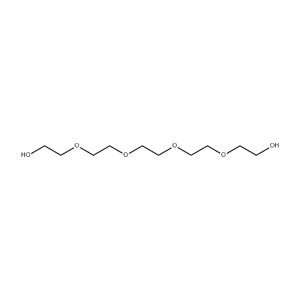 |
PEG linker intermediate: The short, well-defined five-unit polyether chain with hydroxyl end groups provides a hydrophilic spacer ideal for linker construction in bioconjugation and PEGylation research.
Molecular linker intermediate: Serves as a flexible linker for connecting functional moieties in the assembly of complex organic molecules and advanced intermediates.
Fine chemical intermediate: Used in the synthesis of specialty chemicals where the polyether backbone imparts specific solubility and flexibility characteristics.
Laboratory research: Commonly applied in medicinal chemistry laboratories for exploring PEG-modified compounds and their properties.
Process development: Supports the development and optimization of synthetic routes involving PEG spacers for scale-up in fine chemical production.
Consistent product quality: Offered at 98% purity with consistent quality attributes suitable for demanding fine chemical applications.
Flexible global supply: Supports international customers with reliable export arrangements from sample quantities to bulk volumes.
SDS and COA support: Product documentation is provided to meet the needs of export, quality review and regulatory processes.
Packaging and technical service: Flexible options for packaging and professional technical assistance for product selection and application inquiries.
Packaging: Available in 1 kg and 5 kg sample bottles as well as 25 L and 200 L HDPE drums for larger orders. Customized liquid packaging can be arranged upon request.
Storage: Keep in a tightly closed container in a cool, dry and well-ventilated place. Protect from moisture and incompatible materials.
Handling of opened containers: Reseal containers tightly after use and store under recommended conditions to maintain product integrity.
Bulk supply: Suitable packaging and lead times available for pilot-scale and commercial bulk requirements.
General handling: Handle according to good laboratory and industrial hygiene practices. Avoid unnecessary exposure and contact with skin or eyes.
Personal protection: Use appropriate personal protective equipment including gloves, safety goggles and protective clothing during handling.
Documentation review: Review the current Safety Data Sheet (SDS) before use, storage or transportation of the material.
Compatibility: Incompatible with strong oxidizing agents, acid chlorides and acid anhydrides. Conduct compatibility assessment prior to mixing with other substances.
Include the required grade or purity, quantity, preferred packing, destination country/port and required document set.
Octaethylene Glycol, CAS 5117-19-1. Source-derived identification, physical data and applications are provided for catalogue reference; request the current specification, COA and SDS for the…
Nonaethylene Glycol, CAS 3386-18-3. Source-derived identification, physical data and applications are provided for catalogue reference; request the current specification, COA and SDS for the…
Heptaethylene Glycol, CAS 5617-32-3. Source-derived identification, physical data and applications are provided for catalogue reference; request the current specification, COA and SDS for the…
Hexaethylene glycol, CAS 2615-15-8. Source-derived identification, physical data and applications are provided for catalogue reference; request the current specification, COA and SDS for the…
Decaethylene Glycol, CAS 5579-66-8. Source-derived identification, physical data and applications are provided for catalogue reference; request the current specification, COA and SDS for the…