Pyridine
- CAS No.
- 110-86-1
Pyridine, CAS 110-86-1. Source-derived identification, physical data and applications are provided for catalogue reference; request the current specification, COA and SDS for the required…
GTC-469

Nitrogen Heterocycles
N-Ethylcarbazole, CAS 86-28-2. Source-derived identification, physical data and applications are provided for catalogue reference; request the current specification, COA and SDS for the required grade.
9-Ethylcarbazole; 10-Ethylcarbazole; Carbazole, N-ethyl-; N-Ethyl-9H-carbazole; NEC
Supplied catalogue source: GTC-469 · Page 32
The information below is a structured migration from the supplied catalogue snapshot. It is not a current product specification, COA or SDS. Confirm the actual supplier, grade, batch documents, classification, packing and destination requirements for your enquiry.
| CAS No.: | 86-28-2 |
|---|---|
| EC No.: | 201-660-4 |
| Linear Formula: | C₁₄H₁₃N |
| Molecular Weight: | 195.26 |
| Appearance: | White to off-white crystalline solid or powder. |
| Odor: | Faint, characteristic odor. |
| Melting point: | 68-70 °C (lit.) |
| Boiling point: | 166°C/4mm |
| Density: | 1.0590 |
| Solubility: | Insoluble in water; soluble in organic solvents like ethanol, ether, benzene, and chloroform. |
| Flash point: | 186 °C |
| Nature: | Combustible solid. |
| Chemical Structure: | 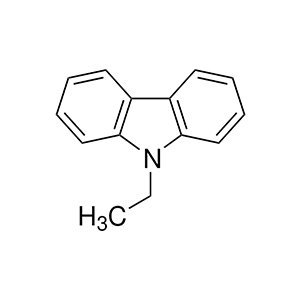 |
Our commitment to delivering high-purity N-Ethylcarbazole ensures a reliable and efficient component for your complex manufacturing and research processes.
N-Ethylcarbazole's unique electronic properties and chemical versatility make it an incredibly valuable compound with applications spanning several advanced industries:
Optoelectronic Materials:
N-Ethylcarbazole is widely used as a building block for organic electronic materials. It is a key precursor for fabricating organic light-emitting diodes (OLEDs), organic photovoltaics, and organic field-effect transistors. Its carbazole moiety contributes to excellent charge transport properties and fluorescence, making it crucial for efficient device performance.
Photoconductors and Photorefractive Materials:
Due to its good charge-transporting capabilities, N-Ethylcarbazole is employed in the development of photoconductive materials, which are essential for applications such as xerography and optical data storage. It is also a component in photorefractive polymers for dynamic holography and optical information processing.
Pharmaceutical and Agrochemical Intermediates:
The carbazole scaffold is present in various biologically active molecules. N-Ethylcarbazole can serve as an intermediate for synthesizing novel pharmaceutical compounds, agrochemicals, and other biologically active substances, leveraging its reactivity for further functionalization.
Dyes and Pigments:
Its inherent fluorescence and chromophoric properties make it useful in the synthesis of certain specialty dyes, pigments, and fluorescent probes for various industrial and analytical applications.
Research and Specialty Chemicals:
N-Ethylcarbazole is a popular chemical in academic and industrial research for exploring new material science applications, particularly in the fields of polymer chemistry and advanced functional materials.
Exceptional Purity & Consistency: Our N-Ethylcarbazole is manufactured to stringent purity specifications, critical for maximizing performance in sensitive optoelectronic applications and ensuring consistent quality in your downstream products.
Commitment to Quality & Innovation: We adhere to the highest industry standards for quality management and environmental responsibility across all our operations, ensuring peace of mind for our clients engaged in cutting-edge research and development.
Include the required grade or purity, quantity, preferred packing, destination country/port and required document set.
Pyridine, CAS 110-86-1. Source-derived identification, physical data and applications are provided for catalogue reference; request the current specification, COA and SDS for the required…
N-Methylpiperidine, CAS 626-67-5. Source-derived identification, physical data and applications are provided for catalogue reference; request the current specification, COA and SDS for the required…
4-Methylpiperidine, CAS 626-58-4. Source-derived identification, physical data and applications are provided for catalogue reference; request the current specification, COA and SDS for the required…
4-Picoline, CAS 108-89-4. Source-derived identification, physical data and applications are provided for catalogue reference; request the current specification, COA and SDS for the required…
3-Aminopyridine, CAS 462-08-8. Source-derived identification, physical data and applications are provided for catalogue reference; request the current specification, COA and SDS for the required…
3-Methylpiperidine, CAS 626-56-2. Source-derived identification, physical data and applications are provided for catalogue reference; request the current specification, COA and SDS for the required…
3-Picoline, CAS 108-99-6. Source-derived identification, physical data and applications are provided for catalogue reference; request the current specification, COA and SDS for the required…
2-Methylpiperidine, CAS 109-05-7. Source-derived identification, physical data and applications are provided for catalogue reference; request the current specification, COA and SDS for the required…