

Palladium(II) acetate

GTC-503

Palladium Compounds

Palladium(II) acetate

CAS No.
3375-31-3
Catalogue ID
GTC-503

Palladium(II) acetate, CAS 3375-31-3. Source-derived identification, physical data and applications are provided for catalogue reference; request the current specification, COA and SDS for the required grade.

Catalogue aliases / related identifiers

Palladium diacetate; Palladous acetate; Bis(acetato)palladium; Acetic acid, palladium(2+) salt; Bis(acetyl)palladium; Diacetatopalladium(II); Palladium(2+) diacetate; Pd(OAc)2

Supplied catalogue source: GTC-503 · Page 73

Reference data — confirm before ordering or use

The information below is a structured migration from the supplied catalogue snapshot. It is not a current product specification, COA or SDS. Confirm the actual supplier, grade, batch documents, classification, packing and destination requirements for your enquiry.


Basic Information of Palladium(II) Acetate

CAS No.3375-31-3
EC No.222-164-4
Chemical FormulaC4H6O4Pd (monomeric); often trimeric in solid state
Molecular Weight224.50 g/mol (monomer basis)
AppearanceReddish-brown to brown crystalline powder
OdorSlight acetic acid-like
Melting point205–224 °C (decomposes)
Boiling pointNot applicable (decomposes)
Densityapprox. 2.19 g/cm³
SolubilityInsoluble in water; soluble in acetic acid, benzene, toluene, acetone, chloroform
Nature (hazards)Skin sensitizer, causes serious eye damage, very toxic to aquatic life with long lasting effects
RIDADRUN 3077, Environmentally hazardous substance, solid, n.o.s. (Palladium(II) acetate), Class 9, Packing Group III
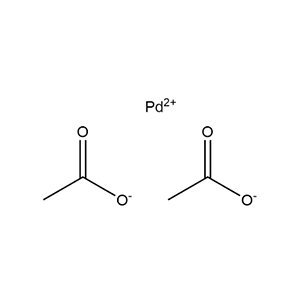
Chemical StructureMolecular Structure of Palladium(II) Acetate

Primary Applications of Palladium(II) Acetate

Palladium(II) Acetate is a cornerstone precatalyst, readily reduced in situ to catalytically active Pd(0) species or functioning directly as Pd(II) in numerous high-impact palladium-catalyzed reactions. Owing to its excellent solubility in organic solvents and reliable reduction profile, it is widely regarded as one of the most versatile entry points into homogeneous palladium catalysis. Its role spans laboratory-scale method development to industrial process chemistry, particularly in systems described under cross-coupling catalytic applications.

  1. Cross-Coupling Reactions
    Serves as the preferred Pd source for Suzuki-Miyaura, Heck, Sonogashira, Negishi, and Stille couplings, enabling efficient C–C bond formation in pharmaceutical and agrochemical intermediates. Under ligand-controlled conditions, Pd(OAc)₂ generates active Pd(0) species capable of oxidative addition into aryl halides, followed by transmetalation and reductive elimination. Its predictable activation behavior makes it particularly suitable for scalable synthesis and complex substrate matrices.

  2. C–H Activation & Functionalization
    Facilitates direct arylation, acetoxylation, olefination, and amidation of C–H bonds, providing atom-economical routes to complex molecules with reduced synthetic steps. In directed C–H activation, Pd(OAc)₂ commonly forms cyclopalladated intermediates, enabling regioselective functionalization that streamlines synthetic pathways and reduces pre-functionalization requirements.

  3. Buchwald-Hartwig Amination & Etherification
    Enables high-yielding C–N and C–O bond formation under mild conditions, critical for accessing nitrogen- and oxygen-containing pharmacophores in drug discovery. When combined with electron-rich phosphine ligands, Palladium(II) Acetate provides efficient catalyst systems for the construction of aryl amines and ethers with broad functional group tolerance.

  4. Pharmaceutical API Synthesis
    Widely employed in multi-kilogram-scale production of active pharmaceutical ingredients, offering excellent selectivity, functional group compatibility, and process robustness. Its well-characterized behavior under GMP-relevant conditions supports reproducibility and impurity control in regulated environments. Broader perspectives on palladium chemistry in regulated pharmaceutical manufacturing can be found in Palladium Compounds: Applications, Categories & Industrial Uses.

  5. Carbonylation & CO-Insertion Reactions
    Catalyzes carbonylative couplings, esterifications, and amidations, providing efficient access to carboxylic acid derivatives and heterocycles in fine chemical synthesis. In these systems, Pd(OAc)₂ participates in migratory insertion steps under CO atmosphere, forming acyl-palladium intermediates that expand molecular complexity in a single catalytic sequence.

  6. Catalyst Development & Mechanistic Studies
    Acts as a standard Pd(II) precursor for ligand screening, mechanistic investigations, and development of novel palladium catalytic systems in academic and industrial R&D. Due to its reproducible reduction kinetics and coordination flexibility, it remains a benchmark compound in comparative catalyst performance studies and structure–activity relationship evaluations.


  • Superior Purity & Batch Consistency
    Advanced quality controls guarantee uniform Pd content, minimal impurities, and reproducible catalytic activity across production lots.

  • Secure Palladium Sourcing
    Transparent, responsible procurement of palladium with inventory management to ensure supply reliability amid market fluctuations.

  • Technical Application Support
    Experienced catalysis team provides reaction optimization, ligand synergy advice, scale-up guidance, and troubleshooting for maximum process efficiency.

  • Comprehensive Regulatory Compliance
    Full documentation suite including Certificates of Analysis, REACH, RoHS, and detailed SDS to facilitate seamless integration into global operations.

  • Sustainability Commitment
    Ethical sourcing practices and precious metal recovery/recycling programs aligned with modern ESG requirements and circular economy goals.


Hazards Classification

  • GHS Classification: Skin Sensitization (Category 1); Serious Eye Damage (Category 1); Aquatic Acute (Category 1); Aquatic Chronic (Category 1)

  • Hazard Statements: H317: May cause an allergic skin reaction; H318: Causes serious eye damage; H410: Very toxic to aquatic life with long lasting effects

  • UN Number: UN 3077

  • Hazard Class: 9 (Miscellaneous dangerous substances and articles)

  • Packing Group: III

GHS07
GHS07: Exclamation mark (sensitizer)
GHS05
GHS05: Corrosive (serious eye damage)
GHS09
GHS09: Environment (aquatic toxicity)
Before you order

Confirm the current commercial product record.

Include the required grade or purity, quantity, preferred packing, destination country/port and required document set.

  • 01Current specification
  • 02Batch or sample COA
  • 03Product- and supplier-specific SDS
  • 04Packing and shipping review
Request product review

INQUIRY

INQUIRY