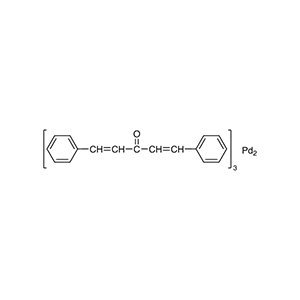


Tris(dibenzylideneacetone)dipalladium(0)

GTC-678

Palladium Compounds

Tris(dibenzylideneacetone)dipalladium(0)

CAS No.
51364-51-3
Catalogue ID
GTC-678

Tris(dibenzylideneacetone)dipalladium(0), CAS 51364-51-3. Source-derived identification, physical data and applications are provided for catalogue reference; request the current specification, COA and SDS for the required grade.

Catalogue aliases / related identifiers

Tris(dibenzylideneacetone)dipalladium; Pd2(dba)3; Dipalladium tris(dibenzylideneacetone); Tris(1,5-diphenyl-1,4-pentadien-3-one)dipalladium; (1,5-Diphenylpenta-1,4-dien-3-one)palladium (3:2); Pd2dba3; Tris[bis(benzylidene)acetone]dipalladium

Supplied catalogue source: GTC-678 · Page 82

Reference data — confirm before ordering or use

The information below is a structured migration from the supplied catalogue snapshot. It is not a current product specification, COA or SDS. Confirm the actual supplier, grade, batch documents, classification, packing and destination requirements for your enquiry.


Basic Information of Tris(dibenzylideneacetone)dipalladium(0)

CAS No.51364-51-3
EC No.257-098-6
Chemical FormulaPd₂(C₁₇H₁₄O)₃
Molecular Weight915.73 g/mol
AppearanceDark purple to black crystalline powder
OdorOdorless to slight characteristic
Melting pointDecomposes >150 °C
Boiling pointNot applicable (decomposes)
Densityapprox. 1.4–1.6 g/cm³
SolubilityInsoluble in water; soluble in toluene, THF, dichloromethane, chloroform (air-sensitive solutions)
Nature (hazards)Harmful if swallowed, may cause long lasting harmful effects to aquatic life, air-sensitive
RIDADRNot regulated (not subject to transport regulations as hazardous material in many classifications)
Chemical StructureMolecular Structure of Tris(dibenzylideneacetone)dipalladium(0)

Primary Applications of Tris(dibenzylideneacetone)dipalladium(0)

Tris(dibenzylideneacetone)dipalladium(0), commonly abbreviated as Pd₂(dba)₃, is a benchmark Pd(0) precatalyst delivering superior activity in ligand-assisted cross-coupling and functionalization reactions across industries. The weakly coordinating dibenzylideneacetone (dba) ligands are readily displaced under reaction conditions, generating highly reactive Pd(0) species suitable for systems described in palladium cross-coupling catalysis, where rapid oxidative addition and controlled catalyst activation are essential.

  1. Suzuki-Miyaura & Other Cross-Couplings
    Enables high-yield aryl-aryl, aryl-alkenyl, and aryl-alkynyl bond formation with broad substrate scope, serving as the gold standard in pharmaceutical and agrochemical intermediate synthesis. The preformed Pd(0) center accelerates oxidative addition into aryl halides, enhancing catalytic turnover under mild conditions.

  2. Buchwald-Hartwig Amination & Etherification
    Facilitates efficient C–N and C–O bond construction under mild conditions, providing access to nitrogen- and oxygen-linked pharmacophores with excellent functional group compatibility. When combined with tailored phosphine ligands, Pd₂(dba)₃ forms highly active homogeneous catalytic systems.

  3. C–H Activation & Functionalization
    Supports direct C–H arylation, olefination, and amidation, offering atom-economical routes to complex molecules in fine chemicals and drug discovery. Its well-defined Pd(0) state enables efficient coordination to directing groups and subsequent bond activation pathways.

  4. Heck & Carbonylative Couplings
    Catalyzes vinylation of aryl halides and carbonylative processes to form ketones, esters, and amides, critical for specialty chemical and heterocyclic synthesis. The labile dba ligands facilitate rapid ligand exchange and active species formation.

  5. Pharmaceutical API Manufacturing
    Widely applied in multi-kilogram-scale Pd-catalyzed steps of active pharmaceutical ingredients, delivering selectivity, scalability, and process robustness. Its predictable activation profile supports reproducible catalyst performance in regulated manufacturing environments.

  6. Catalyst Development & Mechanistic Studies
    Serves as a standard Pd(0) source for ligand screening, mechanistic investigations, and development of novel palladium catalytic systems in R&D laboratories. The defined molecular structure allows systematic evaluation of ligand effects and catalytic pathways.

For a broader overview of palladium material categories—including salts, oxides, supported catalysts, and organometallic systems across industrial sectors—refer to Palladium Compounds: Applications, Categories & Industrial Uses.


  • High Purity & Air-Sensitive Handling
    Advanced manufacturing and packaging under inert conditions preserve compound integrity, minimizing dba dissociation and ensuring maximum catalytic potency.

  • Custom Precursor Specifications
    Tailored Pd content, dba stoichiometry, purity levels, and packaging to perfectly align with your ligand system, solvent, and reaction scale requirements.

  • Secure Palladium Supply Chain
    Transparent, responsible procurement with inventory buffering to deliver supply stability and competitive pricing in dynamic palladium markets.

  • Technical Catalysis Support
    Dedicated specialists provide reaction optimization, ligand synergy advice, scale-up guidance, and troubleshooting to maximize yield and selectivity.

  • Regulatory & Sustainability Compliance
    Comprehensive COA, REACH, RoHS, SDS documentation and palladium recycling programs aligned with global standards and ESG commitments.


Hazards Classification

  • GHS Classification: Acute Toxicity, Oral (Category 4); Aquatic Chronic (Category 4)

  • Hazard Statements: H302: Harmful if swallowed; H413: May cause long lasting harmful effects to aquatic life

  • UN Number: Not regulated

  • Hazard Class: Not classified as hazardous for transport

  • Packing Group: Not applicable

GHS07
GHS07: Exclamation mark (acute toxicity)
GHS09
GHS09: Environment (aquatic hazard)
Before you order

Confirm the current commercial product record.

Include the required grade or purity, quantity, preferred packing, destination country/port and required document set.

  • 01Current specification
  • 02Batch or sample COA
  • 03Product- and supplier-specific SDS
  • 04Packing and shipping review
Request product review

INQUIRY

INQUIRY