Dichloroacetyl Chloride
- CAS No.
- 79-36-7
Dichloroacetyl Chloride, CAS 79-36-7. Source-derived identification, physical data and applications are provided for catalogue reference; request the current specification, COA and SDS for the…
GTC-438
Acyl Halides
Methacryloyl Chloride, CAS 920-46-7. Source-derived identification, physical data and applications are provided for catalogue reference; request the current specification, COA and SDS for the required grade.
Methacrylyl chloride; 2-Methyl-2-propenoyl chloride; Methacrylic acid chloride; 2-Methylacryloyl chloride; α-Methylacryloyl chloride; CH2=C(CH3)COCl; Methacrylic chloride
Supplied catalogue source: GTC-438 · Page 29
The information below is a structured migration from the supplied catalogue snapshot. It is not a current product specification, COA or SDS. Confirm the actual supplier, grade, batch documents, classification, packing and destination requirements for your enquiry.
Methacryloyl chloride is a reactive liquid that features both an acid chloride functionality and a polymerizable methacrylic double bond. It readily participates in acylation reactions with nucleophiles and undergoes radical polymerization, enabling the creation of tailored methacrylic polymers with specific performance characteristics. The compound is typically stabilized to control its tendency to polymerize and requires careful handling to avoid contact with moisture.
| CAS No. | 920-46-7 |
|---|---|
| EC No. | 213-058-9 |
| Linear Formula | CH2=C(CH3)COCl |
| Molecular Weight | 104.53 g/mol |
| Appearance | Colorless to pale yellow liquid with pungent odor |
| Melting Point | Not available (lit.) |
| Boiling point | 95-96 °C (lit.) |
| Density | 1.07 g/mL at 25 °C (lit.) |
| RIDADR | UN 3488 Class 6.1 (3, 8) PG I |
| Chemical Structure | 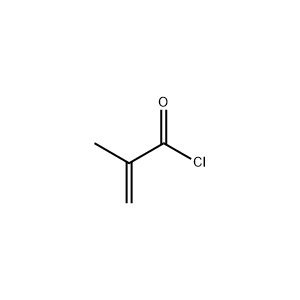 |
Primary monomer for methacrylic polymers: Methacryloyl chloride serves as a key monomer and building block in the industrial production of polymethacrylates and copolymers used in high-performance coatings, adhesives, and plastics.
Chemical intermediate in synthesis: It functions as a reactive acylating agent for introducing the methacryloyl group into organic molecules during the preparation of specialty monomers and fine chemicals.
Polymer and materials applications: Widely used in the formulation of specialty resins, optical polymers, dental materials, and advanced coatings requiring enhanced thermal and mechanical properties.
Pharmaceutical and specialty synthesis: Employed as an intermediate in the development of pharmaceutical compounds and bioactive molecules through selective acylation reactions.
Other industrial uses: Applied in textile treatments, paper coatings, and the manufacture of functional polymers for adhesives and sealants.
High purity specifications and strict batch consistency: Our methacryloyl chloride is produced under rigorous quality control to ensure reliable performance in polymerization and acylation applications.
Complete SDS, COA and dangerous goods documentation available: Comprehensive safety and compliance documentation is provided to facilitate regulatory adherence and safe international transportation.
GHS Classification: Flammable liquids (Category 2) GHS02; Acute toxicity, inhalation (Category 1) GHS06; Skin corrosion (Category 1A) GHS05; Serious eye damage (Category 1) GHS05; Skin sensitization (Category 1) GHS07.
Hazard Statements: H225 - Highly flammable liquid and vapour. H330 - Fatal if inhaled. H314 - Causes severe skin burns and eye damage. H318 - Causes serious eye damage. H302 - Harmful if swallowed. H317 - May cause an allergic skin reaction.
UN Number: UN 3488 | Hazard Class: 6.1 (Toxic) with subsidiary risks 3 (Flammable liquid) and 8 (Corrosive) | Packing Group: I



Include the required grade or purity, quantity, preferred packing, destination country/port and required document set.
Dichloroacetyl Chloride, CAS 79-36-7. Source-derived identification, physical data and applications are provided for catalogue reference; request the current specification, COA and SDS for the…
Acryloyl Chloride, CAS 814-68-6. Source-derived identification, physical data and applications are provided for catalogue reference; request the current specification, COA and SDS for the…
Allyl Chlorooxalate, CAS 74503-07-4. Source-derived identification, physical data and applications are provided for catalogue reference; request the current specification, COA and SDS for the…