GHS Classification: Flammable Liquid (GHS02), Acute Toxicity (GHS06), Skin Corrosion/Irritation (GHS05), Skin Sensitizer (GHS07)
Hazard Statements: Flammable liquid and vapor; harmful if swallowed; causes severe skin burns and eye damage; may cause an allergic skin reaction.
UN Number: UN 2734
Hazard Class: 8 (Corrosive Substances)
Packing Group: II
3-Dimethylaminopropylamine (DMAPA)
GTC-137
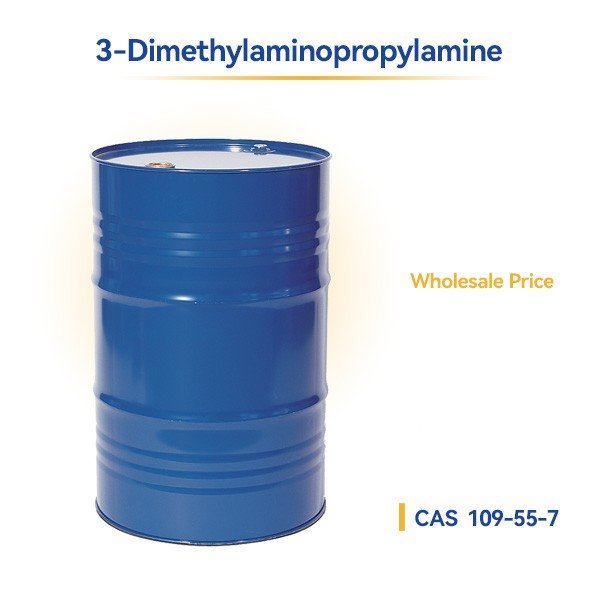
Representative packaging
Amines
3-Dimethylaminopropylamine (DMAPA)
- CAS No.
- 109-55-7
- Catalogue ID
- GTC-137
3-Dimethylaminopropylamine (DMAPA), CAS 109-55-7. Source-derived identification, physical data and applications are provided for catalogue reference; request the current specification, COA and SDS for the required grade.
Catalogue aliases / related identifiers
DMAPA; N,N-Dimethyl-1,3-propanediamine; N,N-Dimethylpropylenediamine; N-(3-Aminopropyl)dimethylamine; 1-Amino-3-(dimethylamino)propane; N,N-Dimethyl-1,3-diaminopropane
Supplied catalogue source: GTC-137 · Page 10
Reference data — confirm before ordering or use
The information below is a structured migration from the supplied catalogue snapshot. It is not a current product specification, COA or SDS. Confirm the actual supplier, grade, batch documents, classification, packing and destination requirements for your enquiry.
3-Dimethylaminopropylamine (DMAPA), also known as N,N-Dimethyl-1,3-propanediamine, is a key chemical intermediate with the CAS number 109-55-7. This colorless to pale yellow, strong-smelling diamine combines a tertiary amino group and a primary amino group, making it highly versatile in chemical synthesis. It is a critical building block, particularly in the production of surfactants for personal care products, and in the creation of durable polymers and coatings.
Basic Information of DMAPA
| CAS No.: | 109-55-7 |
|---|---|
| EC No.: | 203-680-9 |
| Linear Formula: | C5H14N2 |
| Molecular Weight: | 102.18 |
| Appearance: | Colorless to pale yellow clear liquid |
| Odor: | Strong, ammonia-like, or fishy odor |
| Melting Point: | -60 °C |
| Boiling Point: | 133 °C(lit.) |
| Density: | 0.812 g/mL at 25 °C(lit.) |
| Solubility: | Completely miscible with water, alcohol, and ether |
| Flash Point: | 90 °F |
| RIDADR: | UN 2734 8/PG 2 |
| Chemical Structure: |  |
Application Overview
DMAPA is one of the most versatile building blocks in the specialty chemical industry. Its dual-functionality (primary and tertiary amine groups) makes it suitable for reactions that require differential reactivity, leading to a wide array of high-value products across various sectors:
Surfactants and Personal Care: DMAPA is the essential raw material for synthesizing amidoamine intermediates, which are then used to produce amphoteric surfactants like Cocamidopropyl Betaine (CAPB). CAPB is a key ingredient in shampoos, body washes, and liquid soaps for its excellent foam-boosting and mild cleansing properties.
Epoxy Curing Agents: Due to its reactive primary amine group, DMAPA is used in the manufacture of polyamides, which act as high-performance curing agents for epoxy resins in coatings, adhesives, and composites. These systems provide excellent adhesion and chemical resistance.
Polymer and Resin Production: It is used in the synthesis of ion-exchange resins and as a monomer in the production of certain polyamide resins and cationic polymers for water treatment applications (flocculants).
Catalysis: DMAPA and its derivatives can act as catalysts and hardeners in certain polymerization reactions, including some polyurethane formulations.
Corrosion Inhibitors: Its derivatives are often incorporated into formulations used as corrosion inhibitors in oil and gas production and circulating water systems.
Integrated Supply Chain: We manage the entire production and distribution process from source to delivery, minimizing reliance on external factors and guaranteeing a stable supply of DMAPA, even during periods of high market demand.
Application-Specific Purity: Our DMAPA is manufactured with extremely tight specifications on key impurities, specifically tailored to meet the strict requirements of personal care industries where final product clarity, odor, and skin compatibility are paramount.
Hazards Classification




Before you order
Confirm the current commercial product record.
Include the required grade or purity, quantity, preferred packing, destination country/port and required document set.
- 01Current specification
- 02Batch or sample COA
- 03Product- and supplier-specific SDS
- 04Packing and shipping review
INQUIRY
Continue browsing
Related Products
Triisobutylamine
- CAS No.
- 1116-40-1
Triisobutylamine, CAS 1116-40-1. Source-derived identification, physical data and applications are provided for catalogue reference; request the current specification, COA and SDS for the required…
Diethanolamine
- CAS No.
- 111-42-2
Diethanolamine, CAS 111-42-2. Source-derived identification, physical data and applications are provided for catalogue reference; request the current specification, COA and SDS for the required…

Trimethylamine (Anhydrous)
- CAS No.
- 75-50-3
Trimethylamine (Anhydrous), CAS 75-50-3. Source-derived identification, physical data and applications are provided for catalogue reference; request the current specification, COA and SDS for the…
2-Aminoethanol (Monoethanolamine)
- CAS No.
- 141-43-5
2-Aminoethanol (Monoethanolamine), CAS 141-43-5. Source-derived identification, physical data and applications are provided for catalogue reference; request the current specification, COA and SDS for the…
Tri(2-ethylhexyl)amine
- CAS No.
- 1860-26-0
Tri(2-ethylhexyl)amine, CAS 1860-26-0. Source-derived identification, physical data and applications are provided for catalogue reference; request the current specification, COA and SDS for the required…

Triallylamine
- CAS No.
- 102-70-5
Triallylamine, CAS 102-70-5. Source-derived identification, physical data and applications are provided for catalogue reference; request the current specification, COA and SDS for the required…
Triethylamine
- CAS No.
- 121-44-8
Triethylamine, CAS 121-44-8. Source-derived identification, physical data and applications are provided for catalogue reference; request the current specification, COA and SDS for the required…

Tripentylamine
- CAS No.
- 621-77-2
Tripentylamine, CAS 621-77-2. Source-derived identification, physical data and applications are provided for catalogue reference; request the current specification, COA and SDS for the required…