GHS Classification: Acute Toxicity, Oral (GHS06), Acute Toxicity, Dermal (GHS06), Skin Corrosion/Irritation (GHS05), Serious Eye Damage (GHS05)
Hazard Statements: Harmful if swallowed; harmful in contact with skin; causes severe skin burns and eye damage.
UN Number: UN 2735
Hazard Class: 8 (Corrosive Substances)
Packing Group: III
Tri(2-ethylhexyl)amine
GTC-651
Representative packaging
Amines
Tri(2-ethylhexyl)amine
- CAS No.
- 1860-26-0
- Catalogue ID
- GTC-651
Tri(2-ethylhexyl)amine, CAS 1860-26-0. Source-derived identification, physical data and applications are provided for catalogue reference; request the current specification, COA and SDS for the required grade.
Catalogue aliases / related identifiers
Tris(2-ethylhexyl)amine; T-2-EHA; TEHA; Tris(isooctyl)amine; Tri-2-ethylhexylamine
Supplied catalogue source: GTC-651 · Page 40
Reference data — confirm before ordering or use
The information below is a structured migration from the supplied catalogue snapshot. It is not a current product specification, COA or SDS. Confirm the actual supplier, grade, batch documents, classification, packing and destination requirements for your enquiry.
Basic Information of TEHA
| CAS No.: | 1860-26-0 |
|---|---|
| EC No.: | 217-461-0 |
| Linear Formula: | C24H51N |
| Molecular Weight: | 353.67 |
| Appearance: | Clear to pale yellow viscous liquid |
| Odor: | Amine-like odor |
| Melting Point: | -46°C |
| Boiling Point: | 120-125 °C(Press: 0.1 Torr) |
| Density: | 0.817 g/mL at 20 °C(lit.) |
| Solubility: | Fully soluble in hydrocarbons and most organic solvents; insoluble in water |
| Flash Point: | 163°C |
| RIDADR: | UN 2735 8/PG 3 |
| Chemical Structure: | 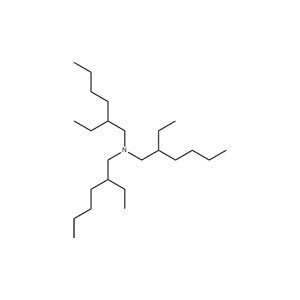 |
Application Overview
Tri(2-ethylhexyl)amine is valued for its hydrophobic tertiary amine structure, which makes it especially useful in solvent extraction, hydrophobic chemical synthesis, and organic phase formulation. Key application areas include:
Solvent Extraction & Metal Separation:
Frequently used in liquid–liquid extraction systems for the separation of rare earth metals, non-ferrous metals, and acidic organic compounds due to its effective complexation and phase-transfer behavior.Surfactant & Emulsifier Raw Material:
Serves as a precursor for cationic and amphoteric surfactants in industrial cleaning, oil–water emulsification, textiles, and chemical processing formulations.Plastic Additives & Modifiers:
Used in formulations for plasticizers, antistatic agents, and polymer modification, improving flexibility and compatibility with hydrophobic polymer matrices.Lubricant & Fuel Additive Synthesis:
Incorporated into high-performance lubricant additive packages to enhance anti-wear performance, detergency, and oxidative stability.Oilfield Chemicals:
Effective in demulsifiers, paraffin inhibitors, asphaltene dispersants, and flow enhancers due to its hydrophobic long-chain structure.Organic Synthesis Intermediate:
Used to produce quaternary ammonium salts, amides, and hydrophobic modifiers in coatings, adhesives, and specialty chemical formulations.Research & Custom Chemical Applications:
Suitable for advanced synthesis projects requiring sterically hindered tertiary amines.
Precision Manufacturing: Produced under tightly controlled conditions to guarantee consistent amine purity and excellent performance in extraction and synthesis applications.
High Reliability in Bulk Supply: Large-scale production capacity ensures stable availability for long-term industrial consumption.
Strong Regulatory and Documentation Support: Full compliance documentation (COA, MSDS, REACH, GHS) for global trade and application audits.
Professional Customer Partnership: Our technical and commercial teams work closely with clients to optimize application performance and streamline procurement processes.
Hazards Classification


Before you order
Confirm the current commercial product record.
Include the required grade or purity, quantity, preferred packing, destination country/port and required document set.
- 01Current specification
- 02Batch or sample COA
- 03Product- and supplier-specific SDS
- 04Packing and shipping review
INQUIRY
Continue browsing
Related Products
Triisobutylamine
- CAS No.
- 1116-40-1
Triisobutylamine, CAS 1116-40-1. Source-derived identification, physical data and applications are provided for catalogue reference; request the current specification, COA and SDS for the required…

Diethanolamine
- CAS No.
- 111-42-2
Diethanolamine, CAS 111-42-2. Source-derived identification, physical data and applications are provided for catalogue reference; request the current specification, COA and SDS for the required…

Trimethylamine (Anhydrous)
- CAS No.
- 75-50-3
Trimethylamine (Anhydrous), CAS 75-50-3. Source-derived identification, physical data and applications are provided for catalogue reference; request the current specification, COA and SDS for the…

2-Aminoethanol (Monoethanolamine)
- CAS No.
- 141-43-5
2-Aminoethanol (Monoethanolamine), CAS 141-43-5. Source-derived identification, physical data and applications are provided for catalogue reference; request the current specification, COA and SDS for the…

Triallylamine
- CAS No.
- 102-70-5
Triallylamine, CAS 102-70-5. Source-derived identification, physical data and applications are provided for catalogue reference; request the current specification, COA and SDS for the required…
Triethylamine
- CAS No.
- 121-44-8
Triethylamine, CAS 121-44-8. Source-derived identification, physical data and applications are provided for catalogue reference; request the current specification, COA and SDS for the required…

Tripentylamine
- CAS No.
- 621-77-2
Tripentylamine, CAS 621-77-2. Source-derived identification, physical data and applications are provided for catalogue reference; request the current specification, COA and SDS for the required…
Tripropylamine
- CAS No.
- 102-69-2
Tripropylamine, CAS 102-69-2. Source-derived identification, physical data and applications are provided for catalogue reference; request the current specification, COA and SDS for the required…