GHS Classification: Flammable Liquid (GHS02), Corrosive (GHS05), Acute Toxicity (GHS06)
Hazard Statements: Highly flammable liquid and vapor; causes severe skin burns and eye damage; harmful if swallowed, in contact with skin, or if inhaled.
UN Number: UN 1214
Hazard Class: 3 (Flammable Liquids)
Packing Group: II
Isobutylamine
GTC-405
Representative packaging

Amines
Isobutylamine
- CAS No.
- 78-81-9
- Catalogue ID
- GTC-405
Isobutylamine, CAS 78-81-9. Source-derived identification, physical data and applications are provided for catalogue reference; request the current specification, COA and SDS for the required grade.
Catalogue aliases / related identifiers
2-Methylpropan-1-amine; 1-Amino-2-methylpropane; 2-Methylpropylamine; Monoisobutylamine; iso-Butylamine; Valamine; IBA
Supplied catalogue source: GTC-405 · Page 26
Reference data — confirm before ordering or use
The information below is a structured migration from the supplied catalogue snapshot. It is not a current product specification, COA or SDS. Confirm the actual supplier, grade, batch documents, classification, packing and destination requirements for your enquiry.
Isobutylamine is a branched aliphatic primary amine known for its strong nucleophilicity, stability, and versatility in organic synthesis. Its compact branched structure makes it suitable for generating sterically influenced intermediates, contributing to improved molecular performance in pharmaceutical, agrochemical, and polymer applications.
Basic Information of Isobutylamine
| CAS No.: | 78-81-9 |
|---|---|
| EC No.: | 201-145-4 |
| Linear Formula: | C4H11N |
| Molecular Weight: | 73.14 |
| Appearance: | Clear, colorless to pale yellow liquid |
| Odor: | Strong amine-like odor |
| Melting Point: | -85 °C (lit.) |
| Boiling Point: | 64-71 °C (lit.) |
| Density: | 0.736 g/mL at 25 °C (lit.) |
| Solubility: | Miscible with most organic solvents; limited water solubility |
| Flash Point: | 15 °F |
| RIDADR: | UN 1214 3/PG 2 |
| Chemical Structure: | 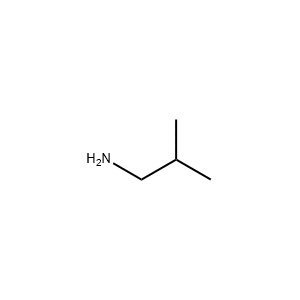 |
Application Overview
Isobutylamine finds broad industrial usage thanks to its ease of reactivity and branched molecular structure, which provides unique steric effects valuable in synthesis. It is widely utilized in pharmaceuticals, crop-protection chemicals, polymer modification, and fine chemical development.
Pharmaceutical Intermediates: Used in synthesizing API side chains, active fragments, and stabilizing groups in medicinal chemistry.
Agrochemicals: An essential raw material for herbicides, plant-growth regulators, pesticide intermediates, and nitrogen-containing crop protection compounds.
Polymer Additives: Applied in resin modification, adhesion promoters, curing systems, and functional monomer production.
Organic Synthesis: Suitable for amide formation, reductive amination, alkylation reactions, catalytic reactions, and custom fine chemical development.
Rubber & Specialty Chemicals: Used in vulcanization accelerators, specialty stabilizers, fragrances, flavors, and dye intermediates.
Laboratory & R&D Applications: Widely adopted in research labs and pilot-scale innovation for creating new amine-based molecules.
Its combination of reactivity, solubility, and molecular branching makes Isobutylamine a highly adaptable choice for both large-scale industrial production and specialized chemical design.
Regulatory and Documentation Support: Comprehensive COAs, MSDS, REACH-related documents, and export certifications available on request.
Responsive Technical Team: Our specialists offer guidance on application fit, formulation compatibility, and production optimization.
Hazards Classification



Before you order
Confirm the current commercial product record.
Include the required grade or purity, quantity, preferred packing, destination country/port and required document set.
- 01Current specification
- 02Batch or sample COA
- 03Product- and supplier-specific SDS
- 04Packing and shipping review
INQUIRY
Continue browsing
Related Products
Triisobutylamine
- CAS No.
- 1116-40-1
Triisobutylamine, CAS 1116-40-1. Source-derived identification, physical data and applications are provided for catalogue reference; request the current specification, COA and SDS for the required…
Diethanolamine
- CAS No.
- 111-42-2
Diethanolamine, CAS 111-42-2. Source-derived identification, physical data and applications are provided for catalogue reference; request the current specification, COA and SDS for the required…

Trimethylamine (Anhydrous)
- CAS No.
- 75-50-3
Trimethylamine (Anhydrous), CAS 75-50-3. Source-derived identification, physical data and applications are provided for catalogue reference; request the current specification, COA and SDS for the…
2-Aminoethanol (Monoethanolamine)
- CAS No.
- 141-43-5
2-Aminoethanol (Monoethanolamine), CAS 141-43-5. Source-derived identification, physical data and applications are provided for catalogue reference; request the current specification, COA and SDS for the…
Tri(2-ethylhexyl)amine
- CAS No.
- 1860-26-0
Tri(2-ethylhexyl)amine, CAS 1860-26-0. Source-derived identification, physical data and applications are provided for catalogue reference; request the current specification, COA and SDS for the required…

Triallylamine
- CAS No.
- 102-70-5
Triallylamine, CAS 102-70-5. Source-derived identification, physical data and applications are provided for catalogue reference; request the current specification, COA and SDS for the required…
Triethylamine
- CAS No.
- 121-44-8
Triethylamine, CAS 121-44-8. Source-derived identification, physical data and applications are provided for catalogue reference; request the current specification, COA and SDS for the required…

Tripentylamine
- CAS No.
- 621-77-2
Tripentylamine, CAS 621-77-2. Source-derived identification, physical data and applications are provided for catalogue reference; request the current specification, COA and SDS for the required…