TAHQ
- CAS No.
- 2770-49-2
TAHQ, CAS 2770-49-2. Source-derived identification, physical data and applications are provided for catalogue reference; request the current specification, COA and SDS for the required…
GTC-264
Dianhydride Monomers
3,3',4,4'-Benzophenonetetracarboxylic dianhydride (BTDA), CAS 2421-28-5. Source-derived identification, physical data and applications are provided for catalogue reference; request the current specification, COA and SDS for the required grade.
Benzophenone-3,3',4,4'-tetracarboxylic dianhydride; 4,4'-Carbonyldiphthalic anhydride; 5,5'-Carbonylbis(isobenzofuran-1,3-dione); Benzophenonetetracarboxylic dianhydride; 4,4'-Diphthalic anhydride ketone
Supplied catalogue source: GTC-264 · Page 66
The information below is a structured migration from the supplied catalogue snapshot. It is not a current product specification, COA or SDS. Confirm the actual supplier, grade, batch documents, classification, packing and destination requirements for your enquiry.
3,3',4,4'-Benzophenonetetracarboxylic dianhydride, commonly known as BTDA, is abenzophenone-type aromatic dianhydride monomer used as a structural building block in high-performance polyimide synthesis. Its aromatic dianhydride structure and benzophenone carbonyl group make BTDA relevant to polyimide systems where thermal resistance, mechanical strength, dimensional stability and processability need to be balanced.
| Product Name | 3,3',4,4'-Benzophenonetetracarboxylic dianhydride |
|---|---|
| Abbreviation | BTDA |
| CAS Number | 2421-28-5 |
| Product Type | Benzophenone-type aromatic dianhydride monomer |
| Molecular Formula | C17H6O7 |
| Molecular Weight | 322.23 g/mol |
| Appearance | Off-white to white powder |
| Purity | ≥ 98% |
| Melting Point | ≥ 224°C; available batch result 224.1–226.7°C |
| Metal Testing | Single metal ≤ 1 ppm; available batch result approved |
| Main Application | Heat-resistant, electronic-grade and specialty polyimide synthesis |
| Package | 1 kg/bottle, 20 kg/drum, or customized packaging |
| Documents | COA, SDS and TDS available upon request |
| Molecular Structure | 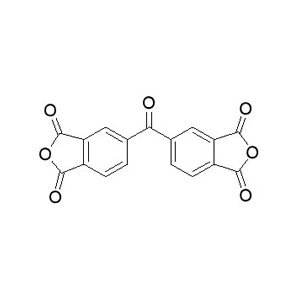 |
| Item | Standard | Available Batch Result |
|---|---|---|
| Appearance | Off-white to white powder | Off-white powder |
| Purity (HPLC) | ≥ 99% | 99.84% |
| Melting Point | ≥ 224°C | 224.1–226.7°C |
| Metal Testing | Single metal ≤ 1 ppm | Approved |
| BTA | ≤ 1.2% | 0.2% |
| Storage Conditions | Sealed container; keep dry; store in a cool and dark place | Based on available COA reference |
The above data is based on an available batch COA for BTDA CAS 2421-28-5. Final specifications, batch data and documentation should be confirmed by the latest COA before order confirmation.
Benzophenone-type aromatic dianhydride structure, relevant to polyimide dianhydride monomers used in heat-resistant PI systems.
Rigid aromatic backbone may support thermal stability, mechanical strength and dimensional control depending on the paired diamine and formulation.
Benzophenone carbonyl structure can influence molecular packing and processability in selected polyimide systems.
BTDA-based PI systems are commonly discussed in electronics and microelectronics polyimide applications where insulation, thermal endurance and mechanical properties are important.
The final material properties depend on dianhydride purity, diamine selection, solvent system, imidization conditions and polymer processing method.
In polyimide synthesis, BTDA may be evaluated with selected polyimide diamine monomers supply portfolio to design thermally stable, mechanically robust and specialty polyimide systems. Rigid aromatic diamines may support heat resistance and dimensional stability, while ether-containing diamines may help improve processability and film-forming behavior.
Fluorinated diamines such as TFMB / TFDB CAS 341-58-2 can be considered when the formulation requires additional control of dielectric behavior or optical properties, while ether-containing diamines such as BAPP CAS 13080-86-9 may support processability and flexibility in selected PI systems.
BTDA is typically used as a structural dianhydride monomer rather than a finished application material. It is commonly considered in heat-resistant, electronic-grade and specialty polyimide material development, where thermal stability, mechanical strength and processability are important design factors.
Electronics and microelectronics polyimide applications – insulation, dielectric and thermally stable polymer material design.
High-temperature aerospace polyimide insulation systems – heat-resistant insulation and structural polymer environments.
Specialty functional polyimide development – aromatic dianhydride selection for advanced polymer research.
Heat-resistant films, varnishes and coatings – BTDA-based polyimides may be considered where thermal endurance and mechanical integrity need to be balanced.
For a broader technical overview of both diamine and dianhydride monomer families, please review Polyimide Monomers: Diamines and Dianhydrides.
BPDA CAS 2420-87-3 – rigid aromatic dianhydride for low-CTE and high-temperature polyimide films.
ODPA CAS 1823-59-2 – ether-containing dianhydride for processable and flexible PI systems.
BAPP CAS 13080-86-9 – ether-containing aromatic diamine for processable and heat-resistant polyimide systems.
Please share the required purity, target specification, quantity, destination country or port, preferred packaging method and required documents so we can review availability, documentation support and export packing options.
Include the required grade or purity, quantity, preferred packing, destination country/port and required document set.
TAHQ, CAS 2770-49-2. Source-derived identification, physical data and applications are provided for catalogue reference; request the current specification, COA and SDS for the required…
4,4'-Oxydiphthalic anhydride (ODPA), CAS 1823-59-2. Source-derived identification, physical data and applications are provided for catalogue reference; request the current specification, COA and SDS for…
1,2,4,5-cyclohexanetetracarboxylic dianhydride (HPMDA), CAS 2754-41-8. Source-derived identification, physical data and applications are provided for catalogue reference; request the current specification, COA and SDS for…
3,3,4,4-diphenylsulfonetetracarboxylicdianhydride DSDA, CAS 2540-99-0. Source-derived identification, physical data and applications are provided for catalogue reference; request the current specification, COA and SDS for the…
3,3',4,4'-Biphenyltetracarboxylic dianhydride (s-BPDA), CAS 2420-87-3. Source-derived identification, physical data and applications are provided for catalogue reference; request the current specification, COA and SDS for…
1,2,3,4-Cyclobutanetetracarboxylic1,2,3,4-dianhydride CBDA, CAS 4415-87-6. Source-derived identification, physical data and applications are provided for catalogue reference; request the current specification, COA and SDS for the…
Bisphenol a diethyl dianhydride (BPADA), CAS 38103-06-9. Source-derived identification, physical data and applications are provided for catalogue reference; request the current specification, COA and…
2,3,3',4'-BiphenyLtetracarboxylic dianhydride (α-BPDA), CAS 36978-41-3. Source-derived identification, physical data and applications are provided for catalogue reference; request the current specification, COA and SDS for…