Wilkinson’s Catalyst
- CAS No.
- 14694-95-2
Wilkinson's Catalyst, CAS 14694-95-2. Source-derived identification, physical data and applications are provided for catalogue reference; request the current specification, COA and SDS for the…
GTC-562
Rhodium Compounds
Rhodium(III) Acetate, CAS 42204-14-8. Source-derived identification, physical data and applications are provided for catalogue reference; request the current specification, COA and SDS for the required grade.
Rhodium acetate; Dirhodium tetraacetate; Dirhodium(II) tetraacetate; Rhodium(II) acetate dimer; Rhodium acetate dimer; Tetrakis(acetato)dirhodium(II); Rhodium(2+) acetate; Bis(acetato)rhodium
Supplied catalogue source: GTC-562 · Page 77
The information below is a structured migration from the supplied catalogue snapshot. It is not a current product specification, COA or SDS. Confirm the actual supplier, grade, batch documents, classification, packing and destination requirements for your enquiry.
| CAS No. | 42204-14-8 |
|---|---|
| EC No. | 255-192-9 |
| Chemical Formula | Ru(CH₃COO)₃ |
| Molecular Weight | 309.24 g/mol (anhydrous basis) |
| Appearance | Dark brown to black powder or hydrated solid |
| Odor | Slight acetic acid-like |
| Melting point | Decomposes before melting (>200 °C) |
| Boiling point | Not applicable (decomposes) |
| Density | approx. 2.0–2.2 g/cm³ |
| Solubility | Soluble in water, alcohols, acetic acid; moderately soluble in acetone |
| Nature (hazards) | Causes skin and eye irritation, may cause allergic skin reaction, harmful if swallowed or inhaled, toxic to aquatic life |
| RIDADR | UN 3077, Environmentally hazardous substance, solid, n.o.s. (Rhodium acetate), Class 9, Packing Group III |
| Chemical Structure | 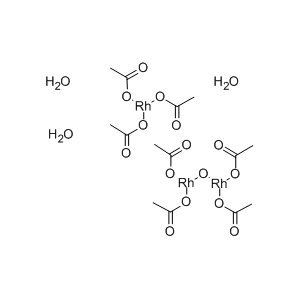 |
Rhodium Acetate serves as a reactive Rh(III) precursor, readily convertible to active rhodium species for catalytic and materials processes.
Homogeneous Hydroformylation Catalysis
Acts as a precursor for Rh-based hydroformylation catalysts, enabling efficient conversion of alkenes to aldehydes in oxo-alcohol production and specialty chemicals.
Supported Rhodium Catalyst Preparation
Used in impregnation or precipitation to deposit Rh on carbon, alumina, silica, or oxide supports, yielding active hydrogenation and reforming catalysts for fine chemicals.
C–H Activation & Functionalization
Facilitates Rh-catalyzed direct C–H arylation, borylation, and annulation reactions, providing atom-economical routes to functionalized molecules in drug discovery.
Thin-Film & Coating Deposition
Serves as a solution-based Rh source for depositing rhodium or rhodium oxide films via spin-coating or electrodeposition in microelectronics and sensors.
Organometallic Complex Synthesis
Enables preparation of mixed-ligand Rh complexes for mechanistic studies, luminescent materials, and functional organometallics in academic and industrial R&D.
Electrocatalysis & Energy Applications
Supports synthesis of Rh-based electrocatalysts for oxygen reduction reaction (ORR) and hydrogen evolution in fuel cells and electrolyzers.
Consistent Rhodium Content & Purity
Precise analytical verification ensures uniform Rh content, low residual impurities, and batch reproducibility for reliable precursor performance.
Secure Precious Metal Sourcing
Transparent, responsible rhodium procurement with inventory buffering to provide supply stability and competitive pricing.
Technical Application Support
Experienced specialists offer guidance on dissolution, reduction protocols, catalyst activation, and process optimization tailored to your applications.
Full Regulatory Compliance
Comprehensive COA, REACH, RoHS, and detailed SDS documentation to facilitate global operations and audits.
Sustainability & Recycling Commitment
Ethical sourcing practices and rhodium recovery/recycling programs aligned with ESG objectives and circular economy principles.
GHS Classification: Skin Irritation (Category 2); Eye Irritation (Category 2A); Specific Target Organ Toxicity, Single Exposure (respiratory) (Category 3); Aquatic Chronic (Category 3)
Hazard Statements: H315: Causes skin irritation; H319: Causes serious eye irritation; H335: May cause respiratory irritation; H413: May cause long lasting harmful effects to aquatic life
UN Number: UN 3077
Hazard Class: 9 (Miscellaneous dangerous substances and articles)
Packing Group: III


Include the required grade or purity, quantity, preferred packing, destination country/port and required document set.
Wilkinson's Catalyst, CAS 14694-95-2. Source-derived identification, physical data and applications are provided for catalogue reference; request the current specification, COA and SDS for the…
Sodium Hexachlororhodate(III), CAS 14972-70-4. Source-derived identification, physical data and applications are provided for catalogue reference; request the current specification, COA and SDS for the…
Rhodium Carbonyl Chloride Dimer, CAS 14523-22-9. Source-derived identification, physical data and applications are provided for catalogue reference; request the current specification, COA and SDS…
Rhodium(III) 2-Ethylhexanoate, CAS 25470-96-6. Source-derived identification, physical data and applications are provided for catalogue reference; request the current specification, COA and SDS for the…
Rhodium(III) Acetylacetonate, CAS 14284-92-5. Source-derived identification, physical data and applications are provided for catalogue reference; request the current specification, COA and SDS for the…
Rhodium(III) Chloride, CAS 10049-07-7. Source-derived identification, physical data and applications are provided for catalogue reference; request the current specification, COA and SDS for the…
Rhodium(III) Chloride Hydrate, CAS 20765-98-4. Source-derived identification, physical data and applications are provided for catalogue reference; request the current specification, COA and SDS for…
Rhodium(III) Iodide, CAS 15492-38-3. Source-derived identification, physical data and applications are provided for catalogue reference; request the current specification, COA and SDS for the…