Wilkinson’s Catalyst
- CAS No.
- 14694-95-2
Wilkinson's Catalyst, CAS 14694-95-2. Source-derived identification, physical data and applications are provided for catalogue reference; request the current specification, COA and SDS for the…
GTC-569
Rhodium Compounds
Get a quote for CAS 12036-35-0Request a sampleSend grade, quantity and destination · reply within 1 business day
Rhodium(III) Oxide, CAS 12036-35-0. Source-derived identification, physical data and applications are provided for catalogue reference; request the current specification, COA and SDS for the required grade.
Rhodium(III) oxide; Rhodium oxide; Rhodium sesquioxide; Dirhodium trioxide; Rhodium trioxide; Rhodium(+3) oxide; Rhodium oxide (Rh2O3); Anhydrous rhodium(III) oxide
Supplied catalogue source: GTC-569 · Page 78
The information below is a structured migration from the supplied catalogue snapshot. It is not a current product specification, COA or SDS. Confirm the actual supplier, grade, batch documents, classification, packing and destination requirements for your enquiry.
| CAS No. | 12036-35-0 |
|---|---|
| EC No. | 234-846-9 |
| Chemical Formula | Rh₂O₃ |
| Molecular Weight | 253.81 g/mol |
| Appearance | Dark grey powder |
| Odor | Odorless |
| Melting point | Decomposes >1000 °C |
| Boiling point | Not applicable (decomposes) |
| Density | 8.20 g/cm³ |
| Solubility | Insoluble in water and most organic solvents; soluble in hot concentrated acids |
| Nature (hazards) | May cause respiratory irritation, skin and eye irritation, harmful if inhaled as dust, toxic to aquatic life |
| RIDADR | Not regulated (non-hazardous for transport under standard classifications; consult SDS for specific handling) |
| Chemical Structure | 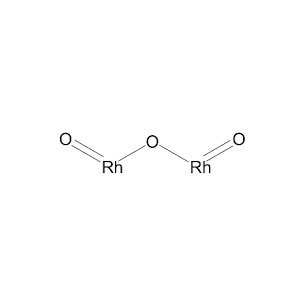 |
Rhodium(III) Oxide excels as a stable, high-performance heterogeneous catalyst and electrode material in oxidation and energy-related technologies.
Selective Oxidation Catalysis
Catalyzes efficient oxidation of alcohols to aldehydes/carboxylic acids and hydrocarbons using air or oxygen, delivering high selectivity in fine chemical and fragrance production.
Automotive Emission Control
Used in three-way catalysts for oxidation of CO and hydrocarbons, providing excellent thermal stability and poison resistance in high-temperature exhaust environments.
Electrocatalysis for Water Splitting
Functions as an efficient oxygen evolution reaction (OER) catalyst in alkaline and acid media, supporting green hydrogen production in electrolyzers.
Supported Catalyst Preparation
Acts as a Rh source for generating rhodium oxide or reduced Rh on various supports for tailored oxidation, hydrogenation, and reforming catalysis in industrial processes.
Electrochemical Capacitors & Sensors
Provides pseudocapacitive behavior with high specific capacitance and cycling stability in supercapacitors and chemical sensors.
Advanced Materials Research
Enables synthesis of rhodium oxide nanoparticles, thin films, or nanostructures for photoelectrocatalysis, electrochromics, and functional coatings.
High Rhodium Content & Activity
Precise analytical control ensures consistent Rh content, optimal crystallinity, and high active surface area for maximum catalytic and electrochemical performance.
Custom Material Specifications
Tailored purity, particle morphology, surface area, and supported variants to perfectly align with your oxidation, electrolysis, or energy storage application.
Consistent Batch-to-Batch Reproducibility
Rigorous testing (ICP, XRD, BET, activity assays) guarantees low variation and predictable performance during scale-up and production.
Secure Rhodium Supply Chain
Responsible sourcing, strategic inventory management, and transparent pricing mitigate volatility and ensure long-term availability.
Technical & Regulatory Support
Expert team provides guidance on catalyst activation, electrode coating, performance optimization, and full documentation (COA, REACH, SDS) for seamless integration.
GHS Classification: Skin Irritation (Category 2); Eye Irritation (Category 2A); Specific Target Organ Toxicity, Single Exposure (respiratory) (Category 3); Aquatic Chronic (Category 3)
Hazard Statements: H315: Causes skin irritation; H319: Causes serious eye irritation; H335: May cause respiratory irritation; H413: May cause long lasting harmful effects to aquatic life
UN Number: Not regulated
Hazard Class: Not classified as hazardous for transport
Packing Group: Not applicable


Include the required grade or purity, quantity, preferred packing, destination country/port and required document set.
Wilkinson's Catalyst, CAS 14694-95-2. Source-derived identification, physical data and applications are provided for catalogue reference; request the current specification, COA and SDS for the…
Sodium Hexachlororhodate(III), CAS 14972-70-4. Source-derived identification, physical data and applications are provided for catalogue reference; request the current specification, COA and SDS for the…
Rhodium Carbonyl Chloride Dimer, CAS 14523-22-9. Source-derived identification, physical data and applications are provided for catalogue reference; request the current specification, COA and SDS…
Rhodium(III) 2-Ethylhexanoate, CAS 25470-96-6. Source-derived identification, physical data and applications are provided for catalogue reference; request the current specification, COA and SDS for the…
Rhodium(III) Acetate, CAS 42204-14-8. Source-derived identification, physical data and applications are provided for catalogue reference; request the current specification, COA and SDS for the…
Rhodium(III) Acetylacetonate, CAS 14284-92-5. Source-derived identification, physical data and applications are provided for catalogue reference; request the current specification, COA and SDS for the…
Rhodium(III) Chloride, CAS 10049-07-7. Source-derived identification, physical data and applications are provided for catalogue reference; request the current specification, COA and SDS for the…
Rhodium(III) Chloride Hydrate, CAS 20765-98-4. Source-derived identification, physical data and applications are provided for catalogue reference; request the current specification, COA and SDS for…