Wilkinson’s Catalyst
- CAS No.
- 14694-95-2
Wilkinson's Catalyst, CAS 14694-95-2. Source-derived identification, physical data and applications are provided for catalogue reference; request the current specification, COA and SDS for the…
GTC-539
Rhodium Compounds
Potassium Hexachlororhodate(III), CAS 13845-07-3. Source-derived identification, physical data and applications are provided for catalogue reference; request the current specification, COA and SDS for the required grade.
Potassium hexachlororhodate; Potassium rhodium(III) chloride; Potassium chlororhodate; Tripotassium hexachlororhodate; Hexachlororhodic(III) acid, tripotassium salt; Potassium hexachlororhodium(III); Potassium rhodium chloride K₃RhCl₆
Supplied catalogue source: GTC-539 · Page 76
The information below is a structured migration from the supplied catalogue snapshot. It is not a current product specification, COA or SDS. Confirm the actual supplier, grade, batch documents, classification, packing and destination requirements for your enquiry.
| CAS No. | 13845-07-3 |
|---|---|
| EC No. | 237-569-5 |
| Chemical Formula | K₃RhCl₆ |
| Molecular Weight | 484.46 g/mol |
| Appearance | Dark red to reddish-brown crystalline powder |
| Odor | Odorless |
| Melting point | Decomposes before melting (>300 °C) |
| Boiling point | Not applicable (decomposes) |
| Density | approx. 2.9–3.1 g/cm³ |
| Solubility | Highly soluble in water (>500 g/L); soluble in methanol, ethanol |
| Nature (hazards) | Causes severe skin burns and eye damage, may cause allergic skin reaction, harmful if swallowed, toxic to aquatic life |
| RIDADR | UN 3288, Toxic solid, inorganic, n.o.s. (Potassium hexachlororhodate(III)), Class 6.1, Packing Group III |
| Chemical Structure | 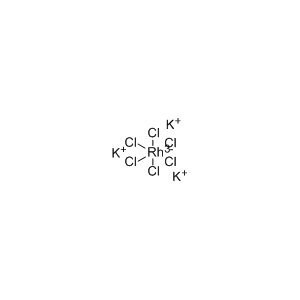 |
Potassium Hexachlororhodate(III) functions as a water-soluble Rh(III) precursor, enabling efficient catalyst generation and rhodium incorporation in aqueous or polar-phase processes.
Wilkinson's Catalyst Preparation
Serves as a convenient rhodium source for synthesizing Wilkinson's catalyst [RhCl(PPh₃)₃] in aqueous or alcoholic media, the benchmark for selective homogeneous hydrogenation in pharmaceutical production.
Supported Rhodium Catalyst Impregnation
Used in wet impregnation of carbon, alumina, or silica supports to create high-dispersion Rh catalysts for hydrogenation, hydroformylation, and automotive emission control.
Hydroformylation & Carbonylation Catalysis
Provides Rh(III) for preparing rhodium-based hydroformylation catalysts, enabling efficient conversion of alkenes to aldehydes in oxo-alcohol and specialty chemical manufacturing.
Organometallic Rhodium Complex Synthesis
Acts as starting material for preparing Rh(III) and reduced Rh(I) complexes with phosphines, amines, or other ligands in homogeneous catalysis and materials research.
C–H Activation & Functionalization
Facilitates Rh-catalyzed direct C–H arylation and borylation in aqueous media, supporting greener synthetic routes to functionalized molecules.
Aqueous-Phase & Green Catalysis
Enables rhodium-catalyzed reactions in water, reducing organic solvent use and enabling environmentally friendlier processes in fine chemical and pharmaceutical production.
Precise Rhodium Content & Purity
Advanced quality assurance ensures accurate Rh assay, low residual impurities, and batch consistency for dependable catalyst or process performance.
Secure Precious Metal Sourcing
Transparent, responsible rhodium procurement with inventory management to ensure supply reliability and competitive pricing.
Technical Process Support
Dedicated specialists provide advice on dissolution, reduction protocols, catalyst activation, and aqueous-phase optimization for enhanced efficiency.
Full Regulatory Compliance
Comprehensive COA, REACH, RoHS, and detailed SDS documentation to facilitate seamless integration into global operations and audits.
Sustainability & Recycling Programs
Ethical sourcing practices and rhodium recovery/recycling programs aligned with ESG goals and sustainable chemistry principles.
GHS Classification: Skin Corrosion/Irritation (Category 1B); Serious Eye Damage (Category 1); Skin Sensitization (Category 1); Acute Toxicity, Oral (Category 4); Aquatic Chronic (Category 2)
Hazard Statements: H314: Causes severe skin burns and eye damage; H317: May cause an allergic skin reaction; H302: Harmful if swallowed; H411: Toxic to aquatic life with long lasting effects
UN Number: UN 3288
Hazard Class: 6.1 (Toxic substances)
Packing Group: III




Include the required grade or purity, quantity, preferred packing, destination country/port and required document set.
Wilkinson's Catalyst, CAS 14694-95-2. Source-derived identification, physical data and applications are provided for catalogue reference; request the current specification, COA and SDS for the…
Sodium Hexachlororhodate(III), CAS 14972-70-4. Source-derived identification, physical data and applications are provided for catalogue reference; request the current specification, COA and SDS for the…
Rhodium Carbonyl Chloride Dimer, CAS 14523-22-9. Source-derived identification, physical data and applications are provided for catalogue reference; request the current specification, COA and SDS…
Rhodium(III) 2-Ethylhexanoate, CAS 25470-96-6. Source-derived identification, physical data and applications are provided for catalogue reference; request the current specification, COA and SDS for the…
Rhodium(III) Acetate, CAS 42204-14-8. Source-derived identification, physical data and applications are provided for catalogue reference; request the current specification, COA and SDS for the…
Rhodium(III) Acetylacetonate, CAS 14284-92-5. Source-derived identification, physical data and applications are provided for catalogue reference; request the current specification, COA and SDS for the…
Rhodium(III) Chloride, CAS 10049-07-7. Source-derived identification, physical data and applications are provided for catalogue reference; request the current specification, COA and SDS for the…
Rhodium(III) Chloride Hydrate, CAS 20765-98-4. Source-derived identification, physical data and applications are provided for catalogue reference; request the current specification, COA and SDS for…