Formaldehyde Solution
- CAS No.
- 50-00-0
Formaldehyde Solution, CAS 50-00-0. Source-derived identification, physical data and applications are provided for catalogue reference; request the current specification, COA and SDS for the…
GTC-269
Aldehydes
Campholenic Aldehyde (Kosher/Halal), CAS 4501-58-0. Source-derived identification, physical data and applications are provided for catalogue reference; request the current specification, COA and SDS for the required grade.
α-Campholenal; ALPHA-CAMPHOLENIC ALDEHYDE; Trimethyl cyclopentenyl acetaldehyde; Aromavert; Α-longine alkenal; alpha-Campholenal; CAMPHOLENIALDEHYDE; CAMPHOLENALDEHYD P
Supplied catalogue source: GTC-269 · Page 16
The information below is a structured migration from the supplied catalogue snapshot. It is not a current product specification, COA or SDS. Confirm the actual supplier, grade, batch documents, classification, packing and destination requirements for your enquiry.
| CAS No.: | 4501-58-0 |
|---|---|
| EC No.: | 224-815-8 |
| Linear Formula: | C10H16O |
| Molecular Weight: | 152.23 |
| Appearance: | Colorless to pale yellow liquid |
| Odor: | Powerful, fresh, camphorous, pine-like, with citrus facets |
| Odor Type: | Herbal |
| Boiling Point: | 93.5-96 °C(Press: 19 Torr) |
| Density: | 0.916 |
| Solubility: | Immiscible with water; soluble in organic solvents. |
| Chemical Structure: | 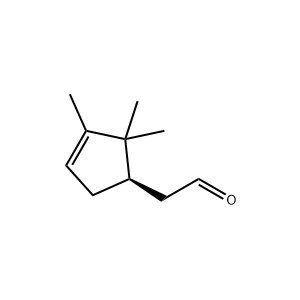 |
Campholenic Aldehyde's high reactivity is maximized as a versatile synthetic building block in the aroma chemical industry:
Synthetic Musk Production: This is its most critical application. It is the primary precursor for a wide range of commercially successful synthetic musk compounds (e.g., Cyclacene, and related molecules) which are vital for adding depth, warmth, and tenacity to fine fragrances and consumer products.
Sandalwood Synthetics: It is also a key starting material for producing numerous synthetic sandalwood notes that serve as ethical and cost-effective alternatives to natural sandalwood oil.
Specialty Flavor & Fragrance Building: While generally not used neat, its derivatives are used to synthesize compounds with pine, camphor, herbal, or specific citrus flavor and fragrance profiles.
Chemical Intermediate: The aldehyde functional group makes it highly reactive, enabling it to undergo various chemical transformations, including reduction to the corresponding alcohol (Campholenol) or condensation reactions.
Aldehyde Purity & Stability: Our Campholenic Aldehyde is meticulously purified to achieve minimal water and acid content. This critical purity ensures that the aldehyde functional group is fully reactive for your intended condensation or synthesis reactions, maximizing the yield of complex downstream fragrance molecules.
Include the required grade or purity, quantity, preferred packing, destination country/port and required document set.
Formaldehyde Solution, CAS 50-00-0. Source-derived identification, physical data and applications are provided for catalogue reference; request the current specification, COA and SDS for the…
Paraformaldehyde, CAS 30525-89-4. Source-derived identification, physical data and applications are provided for catalogue reference; request the current specification, COA and SDS for the required…
Undecanal (Kosher/Halal), CAS 112-44-7. Source-derived identification, physical data and applications are provided for catalogue reference; request the current specification, COA and SDS for the…
Isobutyraldehyde, CAS 78-84-2. Source-derived identification, physical data and applications are provided for catalogue reference; request the current specification, COA and SDS for the required…
Propanal, CAS 123-38-6. Source-derived identification, physical data and applications are provided for catalogue reference; request the current specification, COA and SDS for the required…
Precyclemone B (Halal), CAS 52474-60-9. Source-derived identification, physical data and applications are provided for catalogue reference; request the current specification, COA and SDS for…
Octanal (Halal), CAS 124-13-0. Source-derived identification, physical data and applications are provided for catalogue reference; request the current specification, COA and SDS for the…
Paraxonal (Kosher/Halal), CAS 5462-06-6. Source-derived identification, physical data and applications are provided for catalogue reference; request the current specification, COA and SDS for the…